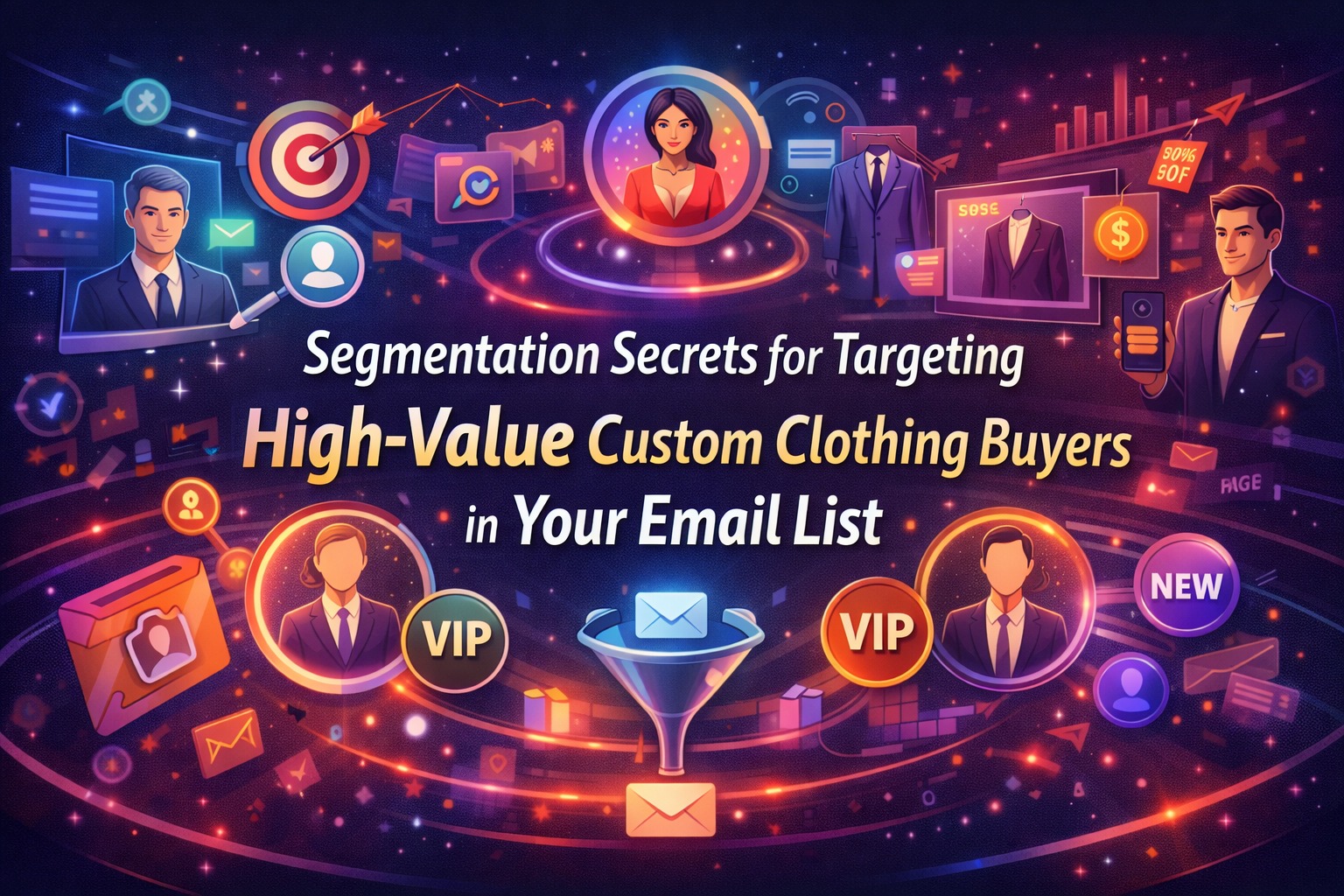
In the hyper-competitive world of custom clothing, think made-to-measure shirts, bespoke suits, personalized denim, or hand-embroidered kurtas your email list is pure gold. Yet most brands treat every subscriber the same: one generic “20% off” blast that lands in the promotions tab and dies there. High-value buyers: the 20% of customers who drive 80% of your revenue deserve better. They spend more, return more often, and refer friends. The secret? Ruthless, intelligent segmentation.
Segmentation turns a cold list into a precision-targeted machine. According to industry benchmarks, segmented email campaigns generate 760% more revenue than non-segmented ones. For custom clothing brands, where personalization is already the product promise, segmented emails can boost open rates by 30-40% and conversion rates by 50%+. This 1500-word guide reveals the exact segmentation secrets top custom clothing brands use to identify, nurture, and monetize their highest-LTV buyers.
Who Exactly Are Your High-Value Custom Clothing Buyers?
High-value buyers aren’t defined by demographics alone. They are the clients who:
- Spend $300+ per order (or the local equivalent in your market).
- Return within 90 days for their second or third custom piece.
- Choose premium fabrics, intricate detailing, or complex alterations.
- Engage with your emails, open lookbooks, and click size guides.
- Leave glowing reviews or share photos on social media.
They buy for weddings, boardroom presentations, milestone birthdays, or simply because they refuse off-the-rack mediocrity. Your goal is to isolate them from the tire-kickers who only want free style quizzes or one-time prom dresses.
Secret #1: RFM Analysis – The Undisputed King of Segmentation
RFM (Recency, Frequency, Monetary) is the single most powerful framework for any e-commerce list, especially custom clothing.
Recency: When did they last purchase? A buyer who ordered a custom blazer 18 days ago is 9x more likely to buy again than someone inactive for 6 months.
Frequency: How many orders in the last 12 months? Three-time buyers are your VIPs.
Monetary: Total spend or average order value. Someone who dropped $1,200 on a full tuxedo setup is not the same as the $89 shirt buyer.
How to implement RFM in your email platform (Klaviyo, Mailchimp, Klaviyo, or ActiveCampaign):
- Export your Shopify/WooCommerce/ custom store data.
- Score each customer 1-5 on each metric.
- Create 125 micro-segments (5x5x5), then group into tiers:
- Champions (top 10%): High RFM. Send them early access to new fabrics and private trunk shows.
- Loyal Customers (next 20%): Strong frequency but lower recency. Re-engage with “We miss your style” campaigns featuring past custom designs.
- At-Risk High-Spenders: High monetary but low recency. Hit them with “Your fabric swatches are waiting” + free alteration reminders.
Real example: A Pakistani custom clothing brand I consulted segmented their list this way and discovered 18% of subscribers drove 71% of revenue. They sent Champions a “Bespoke Birthday” campaign offering free monogramming. Result? 41% open rate and $47,000 in incremental revenue in one month.
Secret #2: Behavioral Segmentation – Track What They Actually Do
Purchase history is table stakes. Layer in digital body language:
- Product page views: Did they spend 3+ minutes on the Italian wool swatch page or the linen summer collection?
- Abandoned cart + abandoned browse: Custom clothing carts are complex (fabric, fit, embroidery). Trigger a 3-email sequence with 15% off + fabric samples mailed to their doorstep.
- Email engagement: Openers vs. clickers vs. “ghosts.” Move high open-rate but low-purchase subscribers into a “Style Curious” segment and feed them educational content first.
- Post-purchase behavior: Who downloaded the care guide PDF? Who used the “Share your custom look” feature? These are your brand ambassadors.
Use UTM parameters and pixel tracking to tag every interaction. In Klaviyo, create segments like “Viewed Custom Shirt Builder 3+ times but never purchased” and nurture them with user-generated content from similar body types.
Secret #3: Preference-Based and Psychographic Segmentation – Speak Their Style Language
Custom clothing is deeply personal. Ask the right questions at checkout or via post-purchase surveys (keep it under 4 questions):
- Preferred fit (slim, regular, relaxed)
- Occasion tags (wedding, office, casual, festive, travel)
- Fabric affinity (organic cotton, Japanese denim, sustainable viscose, heritage tweed)
- Values (ethical sourcing, carbon-neutral shipping, local artisans)
- Style icons (they follow @zaynmalik or @ranveersingh for inspiration?)
Create segments such as:
- Sustainable Luxe – Buyers who chose organic or recycled fabrics.
- Wedding Warriors – Engaged customers or those who bought formal wear in the last 120 days.
- Corporate Climbers – Repeat buyers of business shirts and blazers.
A luxury custom kurta brand in Karachi used this to send “Eid Edit” campaigns segmented by fabric preference. The silk lovers received one collection; the cotton minimalists received another. Conversion jumped 68%.
Secret #4: Engagement + Lifecycle Segmentation – Timing Is Everything
Not every high-value buyer wants the same message at the same time.
- New High-Value (first purchase >$300): Welcome series with “Your first alteration is on us” + stylist consultation booking link.
- Reactivation: 180+ days inactive but past high spender? Send a “We still remember your measurements” campaign with a free virtual fitting session.
- VIP Only: Never discount. Instead offer exclusivity early access to limited-edition fabrics, private WhatsApp stylist groups, or invite-only trunk shows.
- Win-Back: Lost high-value? Use “We noticed you haven’t customized anything lately” + a $50 credit toward their next made-to-measure piece.
Dynamic content blocks in your email tool let one campaign look completely different for each segment. Show the Corporate Climber a navy pinstripe preview while the Wedding Warrior sees ivory silk options.
also read Best Email Marketing Software for Small Business and Startups
Secret #5: Predictive Segmentation & AI-Powered Lookalikes
Modern platforms now predict future value.
- Klaviyo Predictive Analytics or Shopify’s customer predictions flag “Likely to purchase in next 30 days.”
- Build lookalike audiences from your Champions segment and target similar website visitors via Facebook/Instagram ads that feed back into your email list.
- Use AI to analyze past custom orders and suggest “Customers like you also loved…” recommendations in emails.
One European bespoke shirt brand using this approach increased average order value by 34% in their segmented flows.
Implementation Roadmap – 30 Days to Segmented Success
Week 1: Audit your list. Clean invalid emails, merge duplicates, and enrich with RFM scores.
Week 2: Set up 8-10 core segments in your ESP.
Week 3: Design 3 flagship flows (welcome, post-purchase, re-engagement) with dynamic content.
Week 4: Launch, monitor, and A/B test subject lines, send times, and offers.
Pro tips:
- Always include an easy “Update my preferences” link so customers self-segment.
- Respect privacy and be transparent about data usage, especially in GDPR/CCPA-sensitive markets.
- Never over-segment early. Start broad, refine as data accumulates.
- Mobile-first design is non-negotiable; 60%+ of custom clothing emails are opened on phones.
Common pitfalls to avoid:
- Sending too frequently to high-value segments (they unsubscribe fast).
- Offering the same discount to everyone (cheapens your premium positioning).
- Ignoring list hygiene remove complainers immediately.
Measuring What Matters
Track these KPIs for every segment:
- Revenue per email (most important)
- Open rate / Click-through rate / Conversion rate
- Unsubscribe rate
- Customer Lifetime Value growth
- Segment size over time (you want Champions to grow)
Tools like Google Analytics 4 + your ESP dashboard give you the full picture. Aim for at least 3x ROI on every segmented campaign.
Final Word: Segmentation Is Your Unfair Advantage
In custom clothing, the product itself is personal. Your email marketing must match that intimacy. When you stop shouting at everyone and start whispering directly to the right buyer at the right moment with the right fabric swatch, magic happens.
High-value customers don’t want another sale. They want to feel seen, understood, and stylish. Segmentation lets you deliver exactly that.
Start today. Pull your RFM data, create your first three segments, and send one hyper-targeted campaign this week. You’ll be astonished at how fast your most valuable buyers respond when they finally feel like the VIPs they are.
Your inbox is waiting. Make it count.
RFM scoring is one of the most powerful, data-driven ways to segment your customer base, especially for businesses like custom clothing where repeat purchases, high average order values (AOV), and timely re-engagement can dramatically boost revenue. RFM stands for Recency, Frequency, and Monetary value. It ranks customers based on their past buying behavior to identify who is most likely to purchase again and who needs extra attention.
The Three Pillars of RFM Explained
- Recency (R): How recently did the customer make a purchase? This is usually measured in days since the last order. Customers who bought recently are far more likely to respond to offers and buy again. A fresh buyer (e.g., ordered a custom shirt 10 days ago) scores high. Someone inactive for 18 months scores low. Why it matters for custom clothing: Fit preferences, measurements, and style tastes stay relevant shortly after a purchase, but fade over time.
- Frequency (F): How often does the customer buy? This counts the number of orders within a defined period (commonly the last 12 months). Frequent buyers show loyalty and habit. In custom clothing, a customer ordering multiple pieces for different occasions (wedding, office, festive) naturally scores higher.
- Monetary (M): How much has the customer spent? This is typically total spend (or sometimes average order value) over the same period. High spenders are your premium fabric and intricate detailing enthusiasts. A buyer who chooses silk, embroidery, or full bespoke suits contributes more to M than someone buying a single basic shirt.
Higher scores in all three indicate higher customer value. Low scores flag at-risk or lost customers.
How RFM Scoring Works: Step-by-Step
RFM scoring turns raw data into actionable ranks, most commonly on a 1–5 scale (5 = best). Some tools use 1–3 or 1–10, but 1–5 is the most popular for its balance.
Step 1: Gather and Prepare Data
- Export customer transaction history (from Shopify, WooCommerce, or your custom store).
- For each unique customer (by email or ID), calculate:
- Recency: Current date minus date of most recent order (in days).
- Frequency: Total number of orders.
- Monetary: Total revenue from all orders (or average order value).
- Clean the data: Remove test orders, refunds, or duplicates. Decide on a look-back window (e.g., last 12–24 months).
Step 2: Assign Scores Using Quantiles (Percentiles)
The fairest method uses your own data distribution rather than fixed dollar or day thresholds. This creates roughly equal-sized groups.
- Sort all customers by each metric.
- Divide into 5 groups (quintiles), each representing ~20% of your list:
- Score 5: Top 20% (best performers)
- Score 4: Next 20% (21–40%)
- Score 3: Middle 20% (41–60%)
- Score 2: Next 20% (61–80%)
- Score 1: Bottom 20% (worst performers)
For Recency, reverse the logic: The most recent buyers (lowest days since purchase) get 5; the oldest get 1.
Example thresholds (these vary by business always based on your data):
- Recency (days since last purchase):
- 5: 0–30 days
- 4: 31–90 days
- 3: 91–180 days
- 2: 181–365 days
- 1: 365+ days
- Frequency (orders in last 12 months):
- 5: 10+ orders
- 4: 5–9 orders
- 3: 3–4 orders
- 2: 2 orders
- 1: 1 order
- Monetary (total spend):
- 5: Top 20% spenders (e.g., $1,000+)
- 4: Next 20%
- … down to 1: Bottom 20% (lowest spend)
Tools like Klaviyo, Shopify, or Excel/Python (using pandas quantiles) automate this. Some platforms (e.g., Klaviyo) default to a simpler 1–3 scale based on percentiles or fixed time buckets.
Step 3: Combine into RFM Score
Each customer gets a three-digit code, e.g., 555 (best) or 111 (worst).
Common ways to create an overall score:
- Concatenate: 5-4-3 becomes “543”
- Add them: 5 + 4 + 3 = 12 (out of 15)
- Average them
You end up with up to 125 unique combinations (5 × 5 × 5), which you then group into meaningful segments.
Popular RFM Customer Segments and What They Mean
Once scored, map combinations to segments. Here are widely used groupings:
- Champions (e.g., 555, 554, 545, 544): Bought recently, buy often, spend the most. These are your VIP custom clothing buyers ideal for early access to new fabrics, private trunk shows, or free monogramming. They often represent 5–15% of customers but drive 30–50%+ of revenue.
- Loyal Customers (e.g., 454, 444, 544, 435): Good frequency and spend, decent recency. Reliable buyers who respond well to loyalty rewards or “complete your look” offers (e.g., matching accessories for a suit they bought).
- Potential Loyalists (e.g., 551, 541, 431): Recent buyers with moderate frequency/spend. Newer or occasional high-value custom buyers nurture them with style tips, fabric education, or post-purchase care guides to turn them into repeaters.
- At-Risk (e.g., 344, 334, 243, 355): High past frequency/monetary but low recency. Previously strong buyers who haven’t purchased lately. Send “We miss your style” campaigns with measurement reminders or limited-time offers. Act fast these can slip away.
- Hibernating / Can’t Lose Them (e.g., 225, 215, 115): Low recency but high past frequency/monetary. Once-valuable customers who went quiet. Use strong win-back offers like free virtual fittings or credits toward their next bespoke piece.
- Lost / Low-Value (e.g., 111, 112, 121): Low across all metrics. Minimal engagement—deprioritize or use very light re-engagement to test reactivation.
These segments are flexible. Some brands create 8–12 tiers; others start with 5–6. In custom clothing, you can further layer behavioral data (e.g., fabric preferences) on top.
Why RFM Scoring Is Especially Powerful for Custom Clothing Email Lists
- Personalization matches the product: Custom buyers already expect tailoring. RFM lets you tailor messaging—Champions get exclusivity; At-Risk get urgency.
- Higher ROI: Segmented campaigns based on RFM routinely deliver 3–10x better results than blast emails.
- Predicts future value: Recent + frequent + high-spend buyers are statistically more likely to buy premium options (e.g., Italian wool vs. basic cotton).
- Easy to automate: Most email platforms (Klaviyo, ActiveCampaign, Mailchimp) support RFM natively or via tags/properties. Update scores periodically (weekly or monthly).
Implementation Tips and Best Practices
- Start simple: Begin with quintiles on your full list. Refine thresholds after 1–2 months of data.
- Time window matters: Use 12–24 months for Frequency/Monetary to capture seasonality (e.g., Eid, weddings, corporate events in markets like Pakistan).
- Handle edge cases: New customers may have high Recency but low F/M treat them as “Potential Loyalists.”
- Combine with other data: Overlay RFM with preferences (fit style, occasion, sustainable fabrics) for hyper-targeted flows.
- Avoid over-segmentation early: Test 6–8 segments first.
- Monitor movement: Track how customers shift between segments over time (e.g., At-Risk moving back to Loyal).
- Tools: Excel/Google Sheets for manual; Python (pandas) for advanced; Klaviyo/Shopify for automated scoring and flows.
Common Pitfalls to Avoid
- Using fixed thresholds instead of percentiles (your $300 “high spend” may be average in a luxury brand).
- Ignoring Recency decay value drops quickly in fashion.
- Over-mailing Champions (they unsubscribe faster from spam).
- Treating all high-Monetary customers the same as recent ones converts better.
RFM scoring transforms a generic email list into a precision engine. For high-value custom clothing buyers, it highlights exactly who deserves VIP treatment versus who needs a gentle nudge. Once implemented, review your segments monthly, test targeted campaigns, and watch your repeat purchase rate and revenue per email climb.
In practice, many custom clothing brands find that their top 20% RFM customers (Champions + strong Loyals) generate 60–80% of profits. Start by exporting your last year of orders today and calculating basic quintiles you’ll quickly see the segmentation secrets in your own data.