
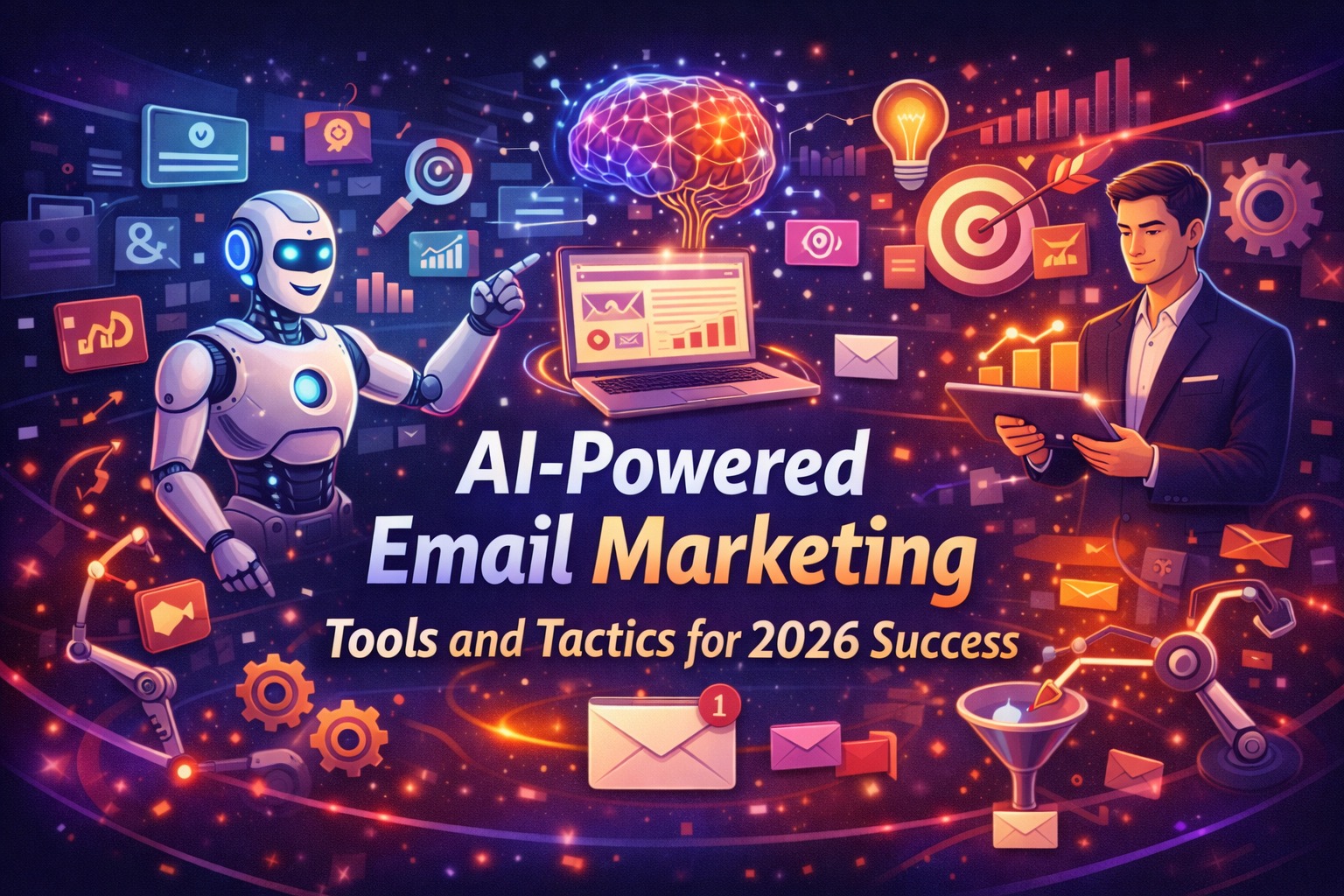
In 2026, email marketing remains one of the highest-ROI channels available to businesses, but the game has changed. AI-powered email marketing is no longer a nice-to-have; it’s the baseline for competitive performance. Brands using AI across segmentation, content creation, timing, and personalization now see 41% higher revenue compared to traditional campaigns.
Whether you run an e-commerce store, B2B SaaS, or service-based business, AI automates repetitive work while delivering hyper-relevant experiences at scale. Open rates climb, click-through rates improve, and subscriber fatigue drops when every email feels personally crafted.
This comprehensive guide breaks down the best AI email marketing tools for 2026 and the proven tactics that top performers use to dominate inboxes. You’ll walk away with actionable strategies to boost engagement, revenue, and efficiency no guesswork required.
Why AI-Powered Email Marketing Matters in 2026
Email marketing still delivers an average ROI of $36–$45 for every $1 spent. Yet manual processes can’t keep pace with rising consumer expectations. By 2026, 89% of marketers expect up to 75% of email operations to be AI-driven.
Key shifts driving this change include:
- Hyper-personalization at scale: AI analyzes behavior, purchase history, and real-time signals to serve dynamic content blocks that change per recipient.
- Predictive analytics: Tools forecast churn risk, next-best actions, and lifetime value to trigger proactive campaigns.
- Smart automation: From send-time optimization to full campaign generation, AI handles what used to take hours or days.
- Privacy-first compliance: With stricter regulations, AI helps maintain clean lists, flag inactive subscribers, and respect consent signals.
Marketers who integrate AI report 22% higher open rates from optimized subject lines and 13.44% better CTR from personalization. The gap between AI adopters and traditional senders is widening fast—41% revenue advantage is the new normal.
try tapstich best pod platform
Top AI Email Marketing Tools for 2026
Here are the standout platforms dominating 2026 leaderboards, based on real-world testing, G2 ratings, and marketer feedback.
- ActiveCampaign Best for advanced automation and generative AI. Its AI crafts full email drafts, subject lines, and complex workflows. Predictive send-time optimization and behavioral targeting shine for mid-market B2B and service businesses. Deep CRM integration turns email into a revenue engine. Pricing starts around $29/month and scales with contacts.
- HubSpot Marketing Hub Ideal for inbound teams. Breeze AI acts as a co-pilot for copy, subject lines, and dynamic content. Seamless CRM + sales forecasting makes it perfect for growing B2B companies. Strong personalization and lead-scoring features. Plans begin at $50–$3,200/month depending on scale.
- Klaviyo E-commerce powerhouse. AI-driven predictive analytics, churn prediction, and next-best-action flows deliver exceptional results for Shopify and WooCommerce stores. Cart abandonment sequences convert at industry-leading rates. Best for DTC brands where email directly impacts revenue.
- Brevo (formerly Sendinblue) Best value for startups and small teams. AI subject-line and send-time optimization, plus SMS and chat integration. Strong deliverability and free tier (300 emails/day) make it accessible. Drag-and-drop editor plus AI content assistance. Starts at $9/month.
- Mailchimp Beginner-friendly with powerful AI upgrades. AI-powered send-time optimization, audience segmentation, content recommendations, and copywriting help. Huge template library and 3,000+ integrations. Free up to 500 contacts; paid plans from $20/month. Great for small businesses and email-first marketers.
- System.io Strong for outbound and sales teams. AI Email Builder generates personalized sequences at scale while maintaining deliverability. Intent signals and automation workflows excel for B2B cold outreach.
- ZoomInfo Enterprise B2B choice. Intent data, predictive scoring, and automated workflows power high-volume sales and marketing outreach. Perfect for mid-market to enterprise teams needing enriched contact data.
- Seventh Sense + Jasper (specialists) Seventh Sense masters AI send-time and frequency optimization. Jasper (or similar like Hoppy Copy) excels at long-form email copy generation while preserving brand voice.
Pro tip: Many teams stack tools e.g., Klaviyo for e-commerce flows + Jasper for copy + Seventh Sense for timing.
Proven AI Email Marketing Tactics for 2026 Success
Tools alone won’t deliver results. These tactics separate average campaigns from revenue-driving machines.
1. Predictive Personalization & Dynamic Content
Stop generic blasts. AI segments audiences by behavior, not just demographics. Dynamic blocks swap products, offers, or images in real time based on browsing history or past purchases. Result: emails that feel one-to-one. Automated flows now drive 37% of email revenue despite being only 2% of sends.
2. AI-Optimized Subject Lines & Send Times
AI tests thousands of variations instantly and predicts performance. Tools like ActiveCampaign and Brevo generate subject lines that boost opens by up to 22%. Individual send-time optimization (considering time zones and past behavior) dramatically improves inbox placement and engagement.
3. Behavioral Trigger Sequences & Autonomous Orchestration
Move beyond the welcome series. AI spots patterns like cart abandonment + browsing similar items and triggers multi-step journeys across email, SMS, and push. Predictive analytics flag high-churn risks for proactive retention campaigns.
4. Hyper-Segmentation with Zero-Party Data
Ask customers preferences directly (zero-party data) and let AI combine it with behavioral signals for micro-segments. Privacy-friendly personalization beats broad targeting every time.
5. Continuous Optimization & A/B Testing at Scale
AI monitors live campaigns and auto-adjusts winners. Multivariate testing on subject lines, CTAs, and layouts happens automatically. Post-send insights refine future sends.
6. Deliverability & Compliance Automation
AI flags spam triggers, cleans invalid addresses, and segments disengaged subscribers. Tools now predict inbox placement and suggest language tweaks to stay out of promotions tabs.
7. Omnichannel Integration
Top performers sync email with SMS, push, and in-app messages. AI orchestrates the right channel at the right moment for maximum impact.
Step-by-Step Implementation Guide
- Audit your current setup: Map existing flows and identify manual bottlenecks.
- Choose your core platform: Match tools to your business model (e-commerce → Klaviyo; B2B → ActiveCampaign/HubSpot).
- Train the AI: Feed brand voice, past high-performing campaigns, and customer data.
- Start small: Pilot one automated flow (e.g., cart abandonment) with full AI assistance.
- Measure and iterate: Track revenue per recipient, not just opens/clicks. Use AI dashboards for real-time insights.
- Maintain human oversight: Review AI-generated copy for tone and accuracy.
Challenges and Best Practices
AI isn’t perfect. Over-reliance can make emails feel robotic always preserve brand voice and add human review for high-stakes campaigns. Data privacy remains critical; focus on consent and first-party insights. Test AI outputs rigorously before full rollout.
Best practice: Treat AI as your co-pilot, not replacement. Combine machine efficiency with human creativity for authentic connections.
The Future of AI-Powered Email Marketing
By late 2026 and beyond, expect fully autonomous journeys where AI continuously learns, predicts, and optimizes without constant human input. Interactive emails, real-time personalization, and deeper CRM integration will become standard.
Brands that embrace AI today will own tomorrow’s inboxes. Those who hesitate risk falling behind as competitors deliver more relevant, timely, and revenue-generating experiences.
Ready to transform your email marketing in 2026?
Start by auditing one underperforming flow and layering in AI optimization. The tools and tactics above give you everything needed for measurable success.
Implement these strategies consistently, and you’ll not only survive 2026 you’ll thrive. Your inbox (and revenue) will thank you.
AI email personalization techniques have evolved dramatically by 2026, transforming generic blasts into hyper-relevant, one-to-one experiences that drive higher engagement, conversions, and loyalty. AI analyzes vast datasets, behavioral signals, purchase history, preferences, and real-time context to tailor every element of an email, from subject lines to dynamic content blocks, without manual effort at scale.
Marketers using advanced AI personalization report up to 3.2x more revenue per recipient compared to traditional batch-and-blast approaches, with open rates and CTRs improving significantly through predictive and dynamic methods. This guide explores the core techniques powering AI-powered email personalization in 2026, practical implementation steps, top tools, best practices, and future trends.
1. Predictive Personalization: Anticipating Needs Before They Arise
Predictive personalization uses machine learning algorithms to forecast customer behavior based on historical and real-time data. Instead of reacting to past actions, AI predicts what a subscriber is likely to need next such as churn risk, next-best product, or optimal engagement timing.
Key applications:
- Churn prediction and retention campaigns: AI flags at-risk subscribers and triggers proactive offers or re-engagement sequences.
- Next-best-action recommendations: Based on browsing patterns, past purchases, and propensity models, emails suggest relevant products or content.
- Lifetime value segmentation: Prioritizing high-value customers with exclusive messaging.
Tools like Klaviyo (for e-commerce) and ActiveCampaign excel here, using predictive analytics to automate flows that feel intuitively timed. In 2026, predictive models integrate with CRMs and CDPs for richer insights, moving beyond demographics to intent-based micro-segments.
2. Dynamic Content Personalization: Modular Emails That Adapt in Real Time
Dynamic content is one of the most powerful AI email personalization techniques. Emails are built from modular blocks (images, text, products, CTAs) that AI assembles differently for each recipient at send time—or even at open time.
How it works:
- AI analyzes recipient data (purchase history, recent site behavior, preferences) to swap in relevant elements.
- Examples: Personalized product carousels, hero images based on browsing, or offer types tailored to loyalty tier.
- Advanced setups use “open-time decisioning” where content updates based on live variables like inventory, weather, or current promotions.
Platforms such as Dynamic Yield, Bloomreach, and Braze enable this with drag-and-drop builders combined with AI decisioning. Movable Ink and similar tools support real-time rendering inside the inbox. Result: Each subscriber sees a unique version, boosting relevance and reducing fatigue.
3. Generative AI for Content Creation and Variation
Generative AI (powered by models like GPT-4o or Claude) goes beyond insertion of names or basic variables. It creates or refines full email copy, subject lines, and even images while preserving brand voice.
Techniques include:
- AI-generated subject lines and preheaders: Predictive models test thousands of variants and select the best per recipient based on past engagement.
- Tone and style adaptation: Casual for younger segments, formal for enterprise—AI auto-adjusts language.
- Full campaign generation: From a high-level brief, AI drafts sequences with personalized narratives.
- Agentic AI workflows: Autonomous agents handle research, drafting, and optimization, learning from replies and performance.
Tools like Jasper, HubSpot’s Breeze AI, Jeeva AI (for cold outreach), and BrazeAI’s copywriting assistant shine here. For cold emails, platforms like SmartWriter.ai or Lyne.ai pull LinkedIn/company data for hyper-specific intros.
4. Behavioral and Real-Time Triggered Personalization
AI monitors signals in real time cart abandonment, site visits, email opens/clicks and triggers or modifies journeys instantly.
- Automated sequences: Welcome flows adapt based on initial engagement; abandoned cart emails include viewed items plus AI-suggested alternatives.
- Omnichannel orchestration: AI decides whether to follow up via email, SMS, or push based on preference and response patterns.
- Hyper-segmentation: Real-time micro-segments form from combined signals (e.g., “browsed premium sneakers + high LTV + recent email open”).
This technique powers autonomous journeys where AI continuously refines paths using decisioning engines.
5. Zero-Party Data Integration for Privacy-First Personalization
Zero-party data information customers voluntarily share via quizzes, preference centers, surveys, or “this or that” games supercharges AI models with explicit preferences.
Why it matters in 2026:
- Complements first-party behavioral data with psychographics (why customers choose certain products).
- Improves AI accuracy and compliance amid stricter privacy rules.
- Enables deeper personalization, such as content topics, communication frequency, or channel preferences.
Collect via interactive emails or post-purchase forms, then feed into AI for tailored recommendations. This privacy-friendly approach often outperforms inferred data alone.
6. Send-Time and Frequency Optimization
AI analyzes individual open/engagement patterns, time zones, and device usage to determine the perfect delivery moment and cadence.
- Personalized send times: Boosts opens by 20-30% by avoiding inbox overload.
- Frequency capping: Prevents fatigue by predicting optimal email volume per subscriber.
Most major platforms (ActiveCampaign, Brevo, Mailchimp) now include built-in AI for this.
Implementation Steps for AI Email Personalization in 2026
- Audit and unify data: Connect your ESP, CRM, CDP, and website analytics for a 360° customer view. Prioritize consented first- and zero-party data.
- Choose the right stack:
- E-commerce: Klaviyo + dynamic content tools.
- B2B/SaaS: ActiveCampaign, HubSpot, or Autobound for signal-based personalization.
- Cold outreach: Jeeva AI, Snov.io, or SmartWriter.ai.
- Enterprise: Braze, Dynamic Yield, or Bloomreach for advanced decisioning.
- Start with pilots: Test one flow (e.g., cart abandonment with dynamic products) or subject line optimization before scaling.
- Train and refine models: Feed high-performing past campaigns and brand guidelines. Use A/B testing and AI dashboards for continuous optimization.
- Maintain human oversight: Review generative outputs for tone accuracy and legal compliance. Add fallback content for edge cases.
- Measure beyond opens: Track revenue per recipient, conversion lift, churn reduction, and engagement depth.
Best Practices and Challenges
- Preserve authenticity: Over-personalization can feel creepy to balance AI with brand voice and human review for high-value sends.
- Privacy and compliance: Rely on consented data; AI can help flag inactive subscribers or clean lists.
- Avoid fatigue: Use predictive models to respect individual preferences.
- Test rigorously: What works for one segment may fail for another AI multivariate testing helps.
- Scalability tip: Start with rule-based personalization and layer on predictive/generative AI gradually.
Common pitfalls include poor data quality (leading to irrelevant suggestions) and ignoring deliverability. AI-optimized language helps stay out of spam folders.
The Future of AI Email Personalization
By late 2026 and beyond, expect fully agentic systems where AI autonomously manages end-to-end journeys, incorporating real-time external signals (e.g., weather, events) and interactive elements. “Intelligent inboxes” and deeper integration with generative tools will make 1:1 personalization the default, not the exception.
Hybrid human-AI teams will focus on strategy while machines handle execution and optimization.
Conclusion: Getting Started with AI Email Personalization
AI email personalization techniques predictive analytics, dynamic content, generative creation, behavioral triggers, and zero-party data enable brands to deliver experiences that feel handcrafted at massive scale. The result is stronger customer relationships, higher ROI, and a competitive edge in crowded inboxes.
Begin by evaluating your current data foundation and piloting one technique (like dynamic product blocks or AI subject lines) in a tool like Klaviyo or ActiveCampaign. Combining multiple layers for compounding gains many marketers see the biggest lifts when predictive, dynamic, and generative AI work together.
In 2026, personalization powered by AI isn’t optional; it’s the foundation of effective email marketing. Implement these techniques thoughtfully, measure results relentlessly, and watch engagement and revenue climb.