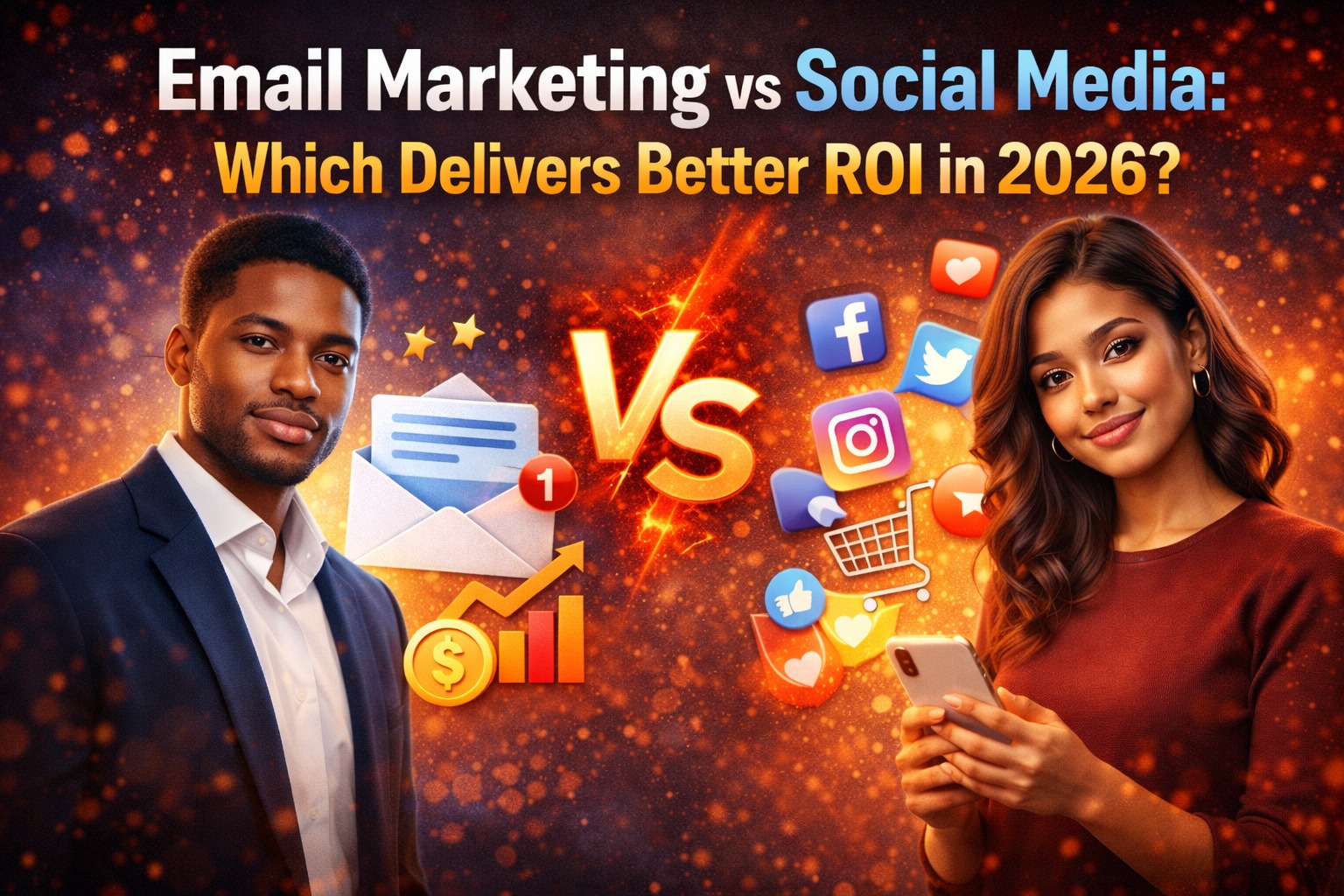
Email Marketing vs Social Media this debate continues to rage among marketers in 2026, but the numbers tell a clear story. While social media excels at discovery, brand awareness, and reaching new audiences, email marketing consistently delivers superior ROI, higher conversion rates, and more predictable revenue, especially for nurtured leads and existing customers.
In 2026, email marketing generated an average return of $36–$42 for every $1 spent, with some reports citing up to $45. In contrast, social media marketing (particularly paid efforts) typically returns around $2.80 per $1 spent, with organic reach continuing to decline due to algorithm changes. This gap makes email the clear winner for bottom-line impact in most businesses.
This in-depth comparison breaks down the data, strengths, weaknesses, and real-world scenarios to help you decide where to allocate your marketing budget in 2026.
The ROI Numbers: Email Marketing Dominates in 2026
The most striking difference in Email Marketing vs Social Media comes down to cold, hard returns:
- Email Marketing ROI: $36–$42 per $1 spent (some sectors like retail/ecommerce see $45+). This translates to a staggering 3,600%–4,200% return.
- Social Media ROI: Approximately $2.80 per $1 spent on average for paid campaigns, equating to roughly 180% ROI. Organic social delivers even lower direct financial returns for most brands.
Email also shines in conversion efficiency:
- Email conversion rates: Often 4.24% overall, with benchmarks around 8% in strong automated flows or welcome sequences. B2C averages 2.8%.
- Social media conversion rates: Typically 0.59%–3%, with many platforms struggling below 1% for direct response.
That’s a 7x performance advantage for email in driving actual sales from engaged users. Automated email flows (like your High-Converting Welcome Email sequence) amplify this further — they often account for a disproportionate share of revenue while representing a tiny percentage of total sends.
also read Holiday Email Marketing Calendar and Campaign Ideas for 2026
Cost structures further favor email. Once you build your list, marginal costs are extremely low compared to ever-rising social ad CPMs and CPCs. Social platforms require continuous ad spend to maintain visibility, while email lets you own the relationship directly.
Strengths of Email Marketing in 2026
Email remains the undisputed king for retention, direct revenue, and personalization:
- Ownership & Control: You own your subscriber list. No algorithm can suddenly limit your reach (unlike Instagram or TikTok, where organic visibility often falls below 5%).
- Precision Targeting: Advanced personalization, behavioral triggers, dynamic content, and AI make every message highly relevant boosting opens, clicks, and conversions.
- Predictable Revenue: Welcome sequences, abandoned cart flows, and post-purchase campaigns deliver consistent results with clear attribution.
- High Engagement with Existing Audience: Subscribers have already opted in, so they’re warmer leads. This leads to better click-to-open rates and lifetime value.
In 2026, AI-powered features (dynamic blocks, predictive send times, and personalized recommendations) are widening email’s advantage even more.
For your High-Converting Welcome Email sequence specifically, these strengths translate into immediate revenue. New subscribers are in peak buying mode, and a well-optimized flow can achieve conversion rates far above social media benchmarks.
Strengths of Social Media Marketing in 2026
Social media still plays a vital role just not always the highest-ROI one:
- Audience Discovery & Brand Awareness: Platforms like TikTok, Instagram, and Facebook excel at reaching cold audiences and building emotional connections through video and community.
- Viral Potential: Organic content or well-crafted ads can explode quickly.
- Visual Storytelling: Ideal for lifestyle brands, fashion, beauty, and products that benefit from demonstration or user-generated content.
- Top-of-Funnel Performance: Great for lead generation and driving traffic to your site or lead magnets.
However, declining organic reach (often under 3% on many platforms) means most serious results now require paid advertising, which drives up costs and lowers net ROI.
Social works best as a complement to email using it to grow your list and then letting email nurture and convert.
Head-to-Head Comparison: Email Marketing vs Social Media
Here’s a clear breakdown based on 2026 data:
| Metric | Email Marketing | Social Media Marketing | Winner |
| Average ROI | $36–$42 per $1 | ~$2.80 per $1 (paid) | |
| Conversion Rate | 4.24%–8% | 0.59%–3% | Email (7x+) |
| Cost Structure | Low after list building | High and rising (ads required) | |
| Audience Ownership | Full control | Platform-dependent | |
| Personalization Power | Extremely high (dynamic + AI) | Moderate (targeting options) | |
| Best For | Retention, direct sales, loyalty | Awareness, discovery, community | Depends on goal |
| Attribution Clarity | High | Complex (multi-touch) | |
| Reach to New Audiences | Requires lead gen | Excellent (especially paid) | Social |
Email clearly wins on efficiency and profitability, while social wins on scale and new customer acquisition.
also read Holiday Email Marketing Calendar and Campaign Ideas for 2026
When to Choose Email Marketing vs Social Media
Prioritize Email Marketing if you want:
- Maximum ROI and sustainable revenue
- Strong customer retention and repeat purchases
- Predictable, controllable campaigns
- Lower long-term customer acquisition costs
Prioritize Social Media if you want:
- Rapid brand growth and awareness
- Reaching new demographics (especially Gen Z via TikTok)
- Visual or community-driven engagement
- Testing viral creative quickly
The Smart Approach in 2026: Integration
The highest-performing brands don’t choose one over the other they create a flywheel:
- Use social media to attract attention and grow your email list (lead magnets, contests, shoppable posts).
- Capture emails and immediately enroll new subscribers into your High-Converting Welcome Email sequence.
- Nurture and convert with personalized email flows.
- Re-engage on social with lookalike audiences or retargeting.
Brands that integrate the two effectively often see 30%+ more retention revenue than those relying on a single channel.
also read Holiday Email Marketing Calendar and Campaign Ideas for 2026
How Your High-Converting Welcome Email Sequence Fits In
Your welcome sequence is a perfect example of email’s ROI power. New subscribers arriving from social ads or organic posts are highly motivated. A strong 4–5 email flow with advanced personalization, strategic emojis, and clear CTAs can convert at rates social media struggles to match.
Focus on turning social-driven signups into email-driven buyers. This hybrid strategy maximizes the strengths of both channels while minimizing their weaknesses.
Final Verdict: Email Marketing Delivers Better ROI in 2026
In the battle of Email Marketing vs Social Media, email marketing wins decisively on ROI, conversion efficiency, and long-term profitability. Social media remains essential for growth and discovery, but treating it as your primary revenue driver is increasingly expensive and unpredictable.
For most businesses, especially e-commerce, SaaS, and service-based brands the highest returns come from building a robust email list and optimizing automated flows like your welcome sequence. Use social media to fuel list growth, then let email do the heavy lifting on conversions and loyalty.
The winners in 2026 will be those who stop pitting the channels against each other and instead build integrated systems where social feeds email, and email drives measurable revenue.
Start by auditing your current welcome flow performance, then allocate more budget and attention to email optimization. The data is overwhelmingly clear: email remains the highest-ROI channel available.
Which channel are you doubling down on this year? Share your results or challenges in the comments.
How to Integrate Email with Social Media for Maximum ROI in 2026
High-Converting Welcome Email sequences prove email’s superior ROI, but the smartest marketers don’t treat email and social media as rivals. They build a powerful flywheel: social media drives discovery and list growth, while email owns the relationship, nurtures leads, and delivers conversions. In 2026, brands that seamlessly integrate the two report up to 90% higher customer retention and 250% higher lifetime value compared to single-channel approaches.
This guide shows you exactly how to integrate email with social media from growing your list using social platforms to feeding social engagement from your email list, and creating unified customer journeys that amplify results across both channels.
Why Integrating Email with Social Media Beats Using Them Separately
Social media excels at awareness and reaching cold audiences, but organic reach remains low (often under 5%) and algorithms control visibility. Email gives you direct, owned access with higher open rates, better personalization, and proven ROI of $36–$42 per $1 spent.
The integration flywheel works like this:
- Social → Attracts attention and captures emails via lead magnets.
- Email → Delivers value, builds trust, and drives sales (including your High-Converting Welcome Email sequence).
- Email subscribers → Become advocates who engage on and share to social.
- Social proof from email-driven actions → Fuels more discovery on social media.
This closed loop reduces reliance on expensive paid social ads while turning one-time followers into loyal, high-value customers.
Step 1: Use Social Media to Grow Your Email List Faster
Social platforms are excellent lead-generation engines when you give people a compelling reason to leave the platform.
Proven Tactics in 2026:
- Lead Magnets in Bio and Posts: Link your Instagram/TikTok bio to a dedicated landing page offering a free ebook, checklist, discount code, or quiz. Promote it consistently in Stories, Reels, and carousels.
- Platform-Specific Tools:
- Instagram & Facebook: Use Meta Lead Ads or link-in-bio tools that feed directly into your email platform (e.g., Klaviyo, Mailchimp integrations).
- LinkedIn: Leverage Lead Gen Forms for B2B audiences.
- TikTok/YouTube: End videos with strong CTAs directing to a link for exclusive content.
- Contests, Giveaways, and Polls: Run social contests where entry requires an email signup. Use Stories polls or quizzes to collect preferences while capturing emails.
- Content Repurposing: Turn popular social threads or Reels into gated content (e.g., “Full guide available in my email list”).
Pro Tip for Your High-Converting Welcome Email: Tag new subscribers by source (e.g., “Instagram Reel signup”). Then personalize the welcome sequence fitness brand followers from workout Reels get tailored workout tips in Email 1.
Aim to convert 5–15% of engaged social followers into email subscribers with strong incentives and frictionless opt-in flows.
Step 2: Promote Your Social Channels Inside Email Campaigns
Don’t let your email list sit in isolation. Use email to drive traffic back to social for community building, user-generated content, and amplification.
Effective Ways to Integrate:
- Welcome Sequence Social Promotion: In your High-Converting Welcome Email (Email 2 or 3), include a section: “Join our community on Instagram for daily tips and behind-the-scenes.” Add social icons with the following buttons.
- Social Share Buttons: Embed one-click share buttons in newsletters and promotional emails so subscribers can easily amplify your content.
- Event Promotion: Use email to boost attendance at live social events, Q&As, or Instagram Lives. Send a pre-event reminder and post-event recap.
- User-Generated Content Requests: Ask subscribers to share their purchases or results on social and tag your brand then feature the best ones in future emails.
This cross-promotion increases social engagement metrics while strengthening the relationship.
Step 3: Create Coordinated Cross-Channel Campaigns
True integration means consistent messaging and offers across channels.
Best Practices:
- Unified Messaging: Launch a campaign on social (e.g., a new product teaser Reel) and follow up with a personalized email sequence that references the social content (“You saw it on Instagram — here’s the full story + exclusive discount”).
- Retargeting Bridge: Use social engagement (likes, comments, video views) to create custom audiences, then retarget non-converters with tailored email nurture flows.
- Real-Time Triggers: Connect platforms so actions on social (e.g., commenting on a post) can trigger automated emails. Tools like Zapier make this simple even without native integrations.
- Omnichannel Journeys: Build flows where social discovery leads to email signup → welcome sequence → purchase → post-purchase email encouraging social review or sharing.
In 2026, platforms with strong omnichannel capabilities (unified customer profiles across email, social, SMS) make this seamless.
Step 4: Leverage Tools and Integrations for Smooth Email-Social Sync
Make integration technical hassle-free:
- Native Integrations: Meta Business Suite with Klaviyo/Mailchimp for Facebook/Instagram leads.
- Zapier or Make: Automate flows between X, TikTok mentions, LinkedIn, and your email list.
- Advanced Platforms: Klaviyo, ActiveCampaign, or Braze offer strong social data syncing and dynamic content based on social behavior.
- Analytics Unification: Track the full customer journey see which social posts drive the most valuable email subscribers and which emails boost social engagement.
Start simple: Connect your main social accounts to your email platform and set up one automated flow (e.g., social lead ad → instant welcome email).
Step 5: Measure and Optimize the Integrated Flywheel
Track these key metrics to prove the power of integration:
- Email list growth rate from social sources.
- Conversion rate of social-driven subscribers in your High-Converting Welcome Email sequence.
- Cross-channel attribution: Revenue influenced by both social touchpoints and email.
- Engagement lift: Social shares or follows originating from email campaigns.
- Overall ROI: Compare integrated campaigns vs. standalone ones.
A/B test elements like lead magnet offers on social or social promotion copy in emails. Use UTM parameters and platform analytics for clear attribution.
Refine monthly — what works on Instagram Stories may differ from TikTok, and email performance varies by audience segment.
Common Mistakes to Avoid When Integrating Email with Social
- Treating social as the end goal instead of a feeder for email.
- Inconsistent branding or offers across channels (confuses subscribers).
- Over-promoting social in every email (keep it value-first).
- Ignoring privacy and consent when syncing data.
- Failing to personalize based on social behavior.
Start Integrating Email with Social Media Today
Integrating email with social media turns rented social attention into owned, high-ROI relationships. Use social to fuel your list growth, let your High-Converting Welcome Email sequence (with advanced personalization and strategic emojis) do the heavy lifting on conversions, and loop engaged subscribers back to social for advocacy.
The result? A self-reinforcing system that delivers better engagement, higher retention, and stronger revenue than either channel alone.
Begin with one clear action: Add a prominent lead magnet promotion to your top-performing social content this week, then ensure new sign-ups enter an optimized welcome flow. Track the results for 30 days and you’ll quickly see why integrated brands dominate in 2026.
Social gets them in the door. Email turns them into customers. Together, they build a marketing engine that compounds over time.
Which integration step will you implement first?