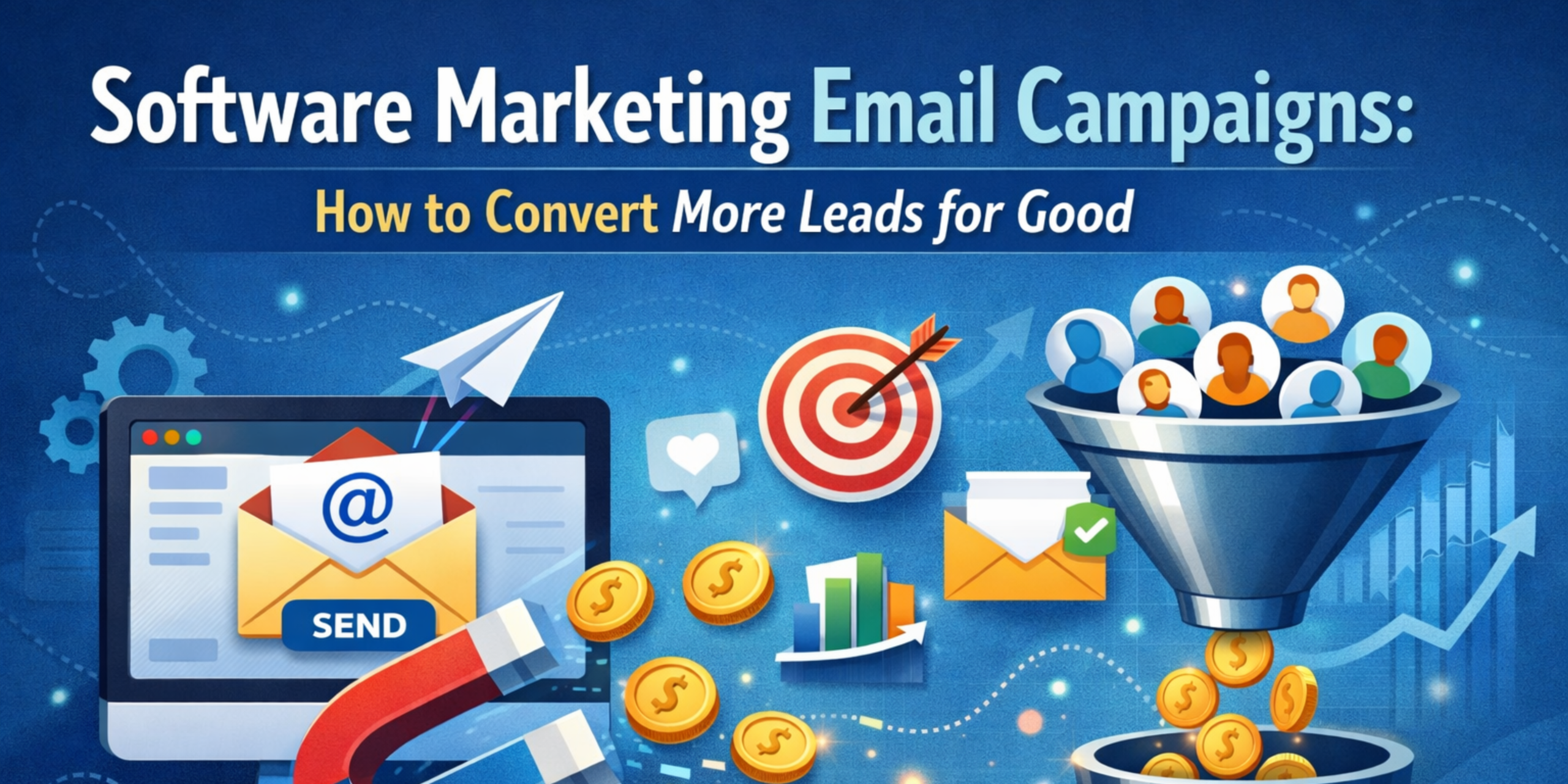
In today’s hyper-competitive SaaS and tech ecosystem, a strategic software marketing email campaign is no longer optional; it’s foundational. Paid acquisition costs continue to rise, buyer journeys are longer, and decision-makers demand education before commitment. Email remains one of the few owned channels that allows software companies to nurture leads, accelerate trials, and increase customer lifetime value without escalating acquisition spend.
This in-depth guide expands on every critical component of software email marketing from lifecycle segmentation to behavioral automation so you can build a scalable, high-converting email engine.
What Is a Software Marketing Email?
A software marketing email is a targeted communication designed to promote, educate, nurture, or convert users within a SaaS or software sales funnel.
Unlike traditional newsletters, software emails are:
- Trigger-based
- Behavior-driven
- Lifecycle-segmented
- Data-informed
- Conversion-optimized
They operate within product-led growth (PLG), sales-assisted, or hybrid acquisition models.
Why Software Marketing Email Is a Revenue Driver
Email directly impacts:
- Trial-to-paid conversion rates
- Demo bookings
- Expansion revenue
- Upsells and cross-sells
- Churn reduction
In subscription-based businesses, incremental improvements in email conversion produce compounding revenue gains over time.
Unlike social platforms, email lists are owned assets. This makes them more resilient and predictable for scaling.
Complete Software Email Lifecycle Model
A high-performing SaaS email strategy covers the entire customer journey.
1. Lead Capture & Welcome Sequence
Objective: Convert subscribers into product-aware prospects.
Include:
- Brand positioning
- Core problem validation
- Social proof
- Soft CTA (demo or trial)
Optimization Tip: Deliver immediate value within the first email to reduce drop-off.
2. Education & Nurture Phase
Objective: Move Marketing Qualified Leads (MQLs) toward sales readiness.
Effective content types:
- Use-case breakdowns
- ROI scenarios
- Customer success stories
- Competitive comparisons
Focus on outcomes, not features.
3. Trial Activation & Onboarding
Objective: Help users experience value quickly.
High-converting onboarding emails:
- Feature walkthroughs
- Setup tutorials
- Progress-based nudges
- Behavioral reminders
Time-to-value is critical in SaaS.
4. Conversion & Upgrade Campaigns
Objective: Convert trial users into paying customers.
Best-performing triggers:
- Trial expiration reminders
- Feature-limit notifications
- Milestone achievement emails
- Personalized ROI reinforcement
Urgency must feel helpful, not pushy.
5. Retention & Expansion Emails
Objective: Increase lifetime value.
Strategies:
- Feature adoption campaigns
- Advanced training
- Cross-sell integrations
- Usage insights reports
Retention emails often outperform acquisition campaigns in ROI.
Core Components of High-Converting Software Marketing Email Campaigns
1. Advanced Segmentation
Segment by:
- Industry
- Company size
- Role (decision-maker vs user)
- Feature usage
- Engagement level
The more relevant the message, the higher the conversion.
2. Behavioral Automation
Automation based on product activity drives significantly higher engagement.
Examples:
- “You haven’t completed setup” reminders
- “You reached 80% of trial usage” alerts
- “Your team invited new members” encouragement
This approach aligns email with real user intent.
3. Persuasive Copywriting Framework
Effective SaaS emails follow this structure:
Hook → Problem → Solution → Proof → CTA
Example structure:
- Opening pain point
- Clear solution explanation
- 3 benefit bullets
- Customer testimonial
- Strong CTA
Keep the copy tight and scannable.
4. Conversion-Focused Design
Best practices:
- One primary CTA
- Visual hierarchy
- White space
- Mobile optimization
- Minimal distractions
Over-designed emails often reduce clarity.
Step-by-Step Framework to Build a Software Marketing Email System
Step 1: Map the Customer Journey
Document:
- Entry points
- Activation milestones
- Drop-off points
- Revenue moments
This identifies where email automation fits.
Step 2: Build Trigger-Based Flows
Create:
- Welcome automation
- Nurture sequence
- Onboarding drip
- Trial countdown sequence
- Re-engagement campaign
Avoid manual batch sending whenever possible.
Step 3: Implement A/B Testing
Test consistently:
- Subject lines
- CTA copy
- Send time
- Personalization depth
- Email length
Optimization should be ongoing, not occasional.
Step 4: Track High-Impact Metrics
Key SaaS email KPIs:
- Open rate
- Click-through rate (CTR)
- Activation rate
- Trial-to-paid conversion
- Revenue per subscriber
- Churn rate
Revenue-based metrics matter more than vanity metrics.
Benefits of Software Marketing Email
When properly implemented, it delivers:
- Predictable lead nurturing
- Higher demo booking rates
- Reduced customer acquisition cost (CAC)
- Improved onboarding completion
- Stronger brand authority
- Better customer engagement
Email strengthens every stage of the SaaS funnel.
Challenges & Limitations
1. Deliverability Issues
Without proper domain authentication and list hygiene, emails may land in spam.
Solution:
- Clean inactive contacts
- Authenticate domain
- Avoid spam-trigger language
2. Content Fatigue
Over-emailing reduces engagement.
Balance automation frequency with value.
3. Misaligned Messaging
If emails don’t match user intent or stage, conversions decline.
Solution:
Invest in lifecycle segmentation.
Advanced Strategies for Higher Conversions
Account-Based Email Marketing (ABM)
For B2B SaaS:
- Personalize emails for high-value accounts
- Reference company-specific use cases
- Coordinate with sales teams
Multi-Channel Reinforcement
Combine email with:
- Retargeting ads
- In-app messaging
- LinkedIn outreach
Integrated campaigns outperform isolated email efforts.
AI-Powered Personalization
Modern tools can:
- Predict churn risk
- Recommend content
- Optimize send time
- Generate dynamic copy variations
AI enhances, but does not replace, strategic thinking.
Mini Case Example (Scenario-Based)
A SaaS analytics company identified that users who connected data sources within 48 hours were 3x more likely to convert.
They implemented:
- 3-step onboarding reminder
- Setup tutorial video
- “Need help?” support CTA
Result: Higher activation and improved trial-to-paid conversions.
The insight wasn’t sending more emails, it was sending the right ones.
Future Trends in Software Marketing Email
- Hyper-personalized dynamic content
- Predictive behavioral workflows
- Integration with product analytics
- Interactive email components
- Privacy-focused segmentation strategies
As third-party cookies decline, owned channels like email will grow in importance.
Common Mistakes to Avoid
- Sending generic newsletters to all users
- Overloading with feature lists
- Ignoring behavioral triggers
- Using multiple CTAs
- Neglecting performance tracking
Precision wins in SaaS email marketing.
System.io: The Ultimate 2026 for email marketing software
How Do You Create a High-Converting Software Marketing Email?
To create a high-converting software marketing email, segment users by lifecycle stage, trigger emails based on behavior, focus on benefits over features, use a single strong CTA, include social proof, and continuously A/B test subject lines and messaging for optimization.
Scaling Revenue with Software Marketing Email
A high-performance software marketing email strategy is built on segmentation, automation, relevance, and optimization. It transforms email from a broadcast channel into a precision revenue tool.
Instead of asking, “How many emails should we send?” ask:
- Are they lifecycle-aligned?
- Are they behavior-triggered?
- Are they conversion-focused?
When those answers are yes, email becomes one of your most profitable SaaS growth channels.
Best Software Marketing Email Platforms: Comparison and Recommendation
Choosing the right platform for your software marketing email strategy depends on automation depth, lifecycle complexity, budget, and scalability requirements. Below is a structured comparison of leading tools used by SaaS and software businesses.
Software Marketing Email Platform Comparison
| Platform | Best For | Automation Depth | CRM Integration | Behavioral Tracking | Ease of Use | Ideal Business Size |
|---|---|---|---|---|---|---|
| ActiveCampaign | Advanced SaaS automation | High | Built-in CRM | Strong tagging & triggers | Moderate | Small–Mid SaaS |
| Customer.io | Product-led growth | Very High | API-based | Real-time event tracking | Technical | Growth SaaS |
| HubSpot Marketing Hub | Sales-aligned B2B SaaS | High | Native CRM | Advanced segmentation | Moderate | Mid–Enterprise |
| Marketo | Enterprise automation | Very High | Enterprise CRM | Advanced personalization | Complex | Enterprise |
| SendGrid | Infrastructure-level email | API-driven | External | Transaction-focused | Technical | Technical Teams |
| Systeme.io | All-in-one simplicity | Moderate | Basic | Tag-based triggers | Easy | Startup–Small SaaS |
Expert Recommendation
For most SaaS and software businesses, the ideal platform depends on operational maturity:
- If deep behavioral automation and product-event tracking are required, Customer.io is typically preferred.
- If CRM alignment with sales teams is essential, HubSpot is commonly selected.
- If enterprise-grade orchestration and dynamic personalization are needed, Marketo is often implemented.
- If cost efficiency and simplicity are prioritized, Systeme.io becomes a practical option.
For early-stage SaaS companies, overcomplicating the tech stack often slows execution. Automation precision matters, but speed and clarity often produce faster revenue impact.
Where Systeme.io Fits Strategically
Systeme.io positions itself as an all-in-one marketing solution combining:
- Email campaigns
- Automation workflows
- Funnel builder
- Landing pages
- Checkout pages
- Basic CRM
Rather than focusing purely on enterprise-level automation depth, it emphasizes operational simplicity and funnel-driven marketing.
Practical Use Case for Software Marketing Email
A SaaS startup launching a new productivity tool could use Systeme.io to:
- Create a lead capture landing page
- Trigger a multi-email nurture sequence
- Deliver a webinar funnel
- Automatically start a trial onboarding series
- Send reminder emails before trial expiration
- Trigger upgrade or discount emails
All processes can be managed within one dashboard, reducing integration complexity and technical overhead.
When Systeme.io Is a Strong Choice
Systeme.io is typically suitable when:
- The marketing team is small
- Budget efficiency is a priority
- Funnel-based email automation is the main strategy
- Enterprise CRM alignment is not required
- Fast deployment is more important than deep customization
It may not be optimal for:
- Enterprise SaaS with large sales teams
- Advanced behavioral event tracking requirements
- Complex multi-product CRM environments
Which Platform Is Best for Software Marketing Email?
The best software marketing email platform depends on business scale and automation needs. Growth-stage SaaS companies often use ActiveCampaign or system.io for advanced automation, enterprises choose HubSpot or Marketo for CRM alignment, while startups prefer Systeme.io for its all-in-one simplicity and funnel-based email workflows.
FAQ Section
1. What is a software marketing email?
A software marketing email is a targeted email campaign designed to promote, educate, or convert leads and customers within a SaaS or software sales funnel using segmentation and automation.
2. How often should SaaS companies send marketing emails?
Frequency varies by lifecycle stage, but automation-driven emails triggered by behavior perform better than fixed weekly batch emails.
3. What makes SaaS email campaigns different from traditional email marketing?
SaaS email campaigns rely heavily on behavioral triggers, product usage data, and lifecycle segmentation to drive activation and subscription conversions.
4. How do you improve trial-to-paid conversion with email?
Use onboarding sequences, usage-based nudges, trial countdown reminders, testimonials, and personalized benefit reinforcement.
5. What tools are essential for software email automation?
A CRM-integrated email platform with advanced segmentation, behavioral tracking, analytics, and A/B testing is essential.
6. What are the most important metrics to track?
Trial activation rate, conversion rate, churn rate, revenue per subscriber, and engagement metrics.
7. Should software emails focus on features or outcomes?
Always prioritize outcomes and benefits over raw feature descriptions.
8. Is email still effective for SaaS growth?
Yes. Email remains one of the highest-ROI channels for nurturing, activation, retention, and expansion in software businesses.