
If your business isn’t leveraging email marketing yet, you are leaving significant revenue on the table. Email remains one of the highest ROI marketing channels, with brands reporting $30–$40 returned for every $1 spent. To achieve these results, you need the right software for email marketing, not just any tool that can send messages.
This guide provides a comprehensive comparison of the top email marketing platforms, including features, pricing, pros and cons, and real use cases. Additionally, I provide a detailed review and mini-case study for Systeme.io, which I personally recommend for small and medium businesses.
Why Email Marketing Software Matters
Manual email outreach from Gmail or Outlook is not scalable. Professional email marketing software provides:
Automation: Send welcome sequences, cart abandonment emails, lead nurturing, and drip campaigns automatically.
Segmentation: Deliver targeted messages to different audience groups instead of sending generic emails.
Analytics: Track open rates, click-through rates, conversion rates, and unsubscribes for actionable insights.
Compliance: Ensure your emails comply with GDPR, CAN-SPAM, and other email regulations.
Personalization at Scale: Merge tags and dynamic content make emails feel personal and increase engagement.
Using dedicated email software transforms your campaigns from generic messaging to a high-performing revenue-driving tool.
Best Email Marketing Software for Small Business and Startups
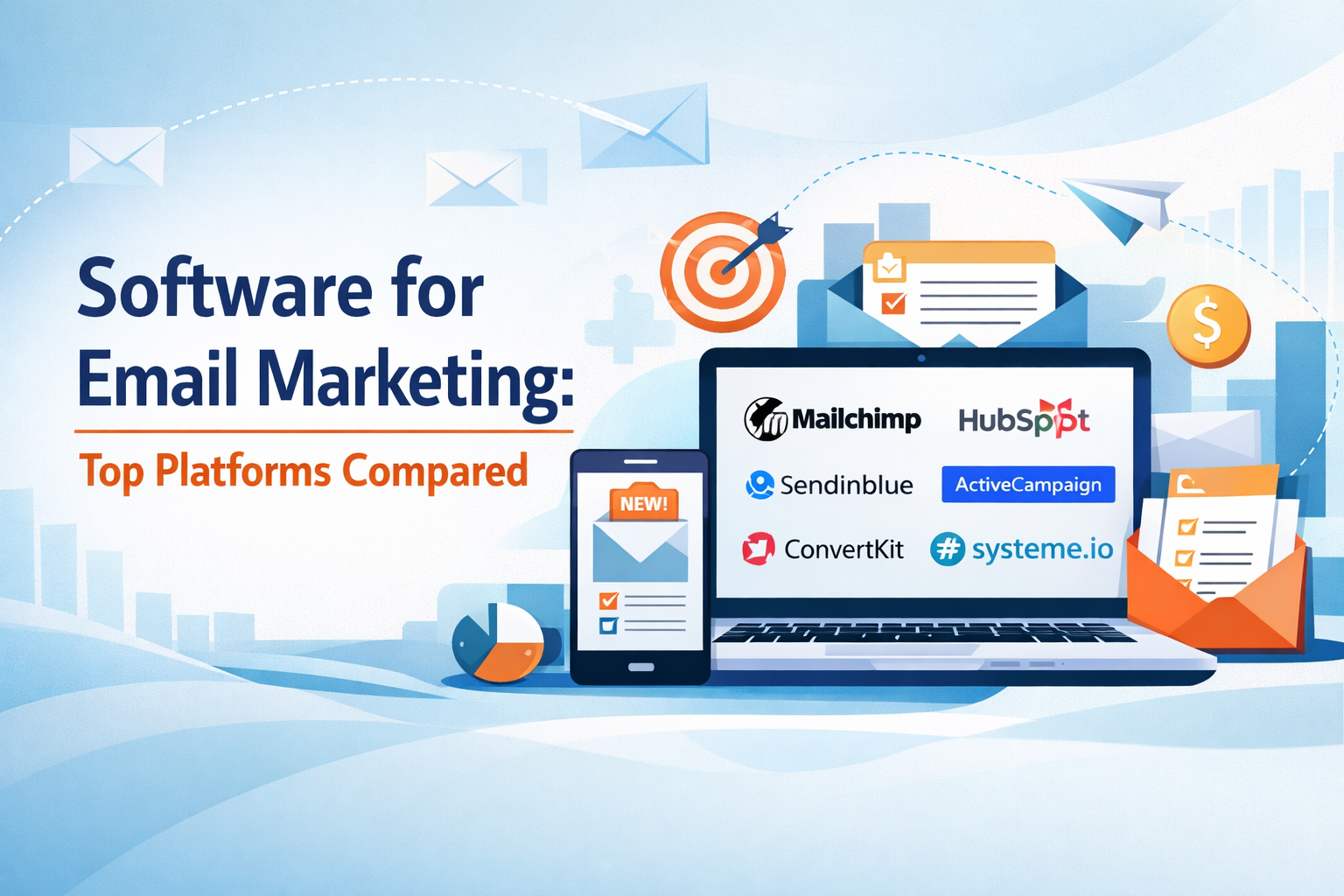
Quick Comparison — Top Email Marketing Software (2026)
| Platform | Best For | Free Plan | Starting Price | Key Features | Downsides |
| Mailchimp | Beginners & Small Businesses | Yes (500 contacts) | $13/mo | Templates, basic automation | Paid plans needed for advanced features |
| HubSpot Email Marketing | CRM-focused businesses | Yes (limited) | $25/mo | Advanced segmentation, CRM integration, analytics | High cost, steep learning curve |
| Sendinblue | E-commerce & multi-channel | Yes (300 emails/day) | $25/mo | Email + SMS marketing, automation workflows | Limited templates, free plan has daily limits |
| ActiveCampaign | Advanced automation & segmentation | No | $29/mo | Behavioral targeting, conditional content, deep analytics | Steep learning curve, higher price |
| ConvertKit | Creators & solopreneurs | Yes (1,000 subscribers) | $29/mo | Tag-based subscriber management, landing pages | Limited design options |
| Systeme.io | All-in-one business platform | Yes (limited) | $27/mo | Funnels, courses, automations, email marketing | Design templates are functional but not advanced |
Detailed Breakdown of Top Platforms
Mailchimp — Best for Beginners & Small Businesses
Mailchimp is user-friendly with drag-and-drop email building and pre-built templates. It also provides analytics for small teams.
Best for: Entrepreneurs and small business owners needing simple newsletters.
Limitations: Free plan is limited; advanced automation requires paid plans.
Ideal if: You want a quick setup and simple newsletter campaigns without complex workflows.
HubSpot Email Marketing — Best for CRM-Focused Businesses
HubSpot combines email marketing with a powerful CRM. Its segmentation and analytics capabilities make it ideal for lead nurturing and sales-focused campaigns.
Best for: Mid-sized businesses with sales teams.
Limitations: More features mean a higher cost; the learning curve is steeper.
Ideal if: You want email marketing fully integrated with customer lifecycle management.
Sendinblue — Best for E-commerce and Multi-Channel Campaigns
Sendinblue combines email marketing, SMS, and chat marketing in one platform. Automation workflows are particularly strong for e-commerce triggers like abandoned cart emails.
Best for: Online stores and businesses looking for multi-channel campaigns.
Limitations: Templates are limited; free plan restricts daily email volume.
Ideal if: You need email marketing plus SMS notifications for conversions.
ActiveCampaign — Best for Advanced Automation
ActiveCampaign excels in complex automation and behavioral targeting. Conditional content and deep analytics make it ideal for optimizing marketing funnels.
Best for: Growth marketers and mid-to-large businesses with sizable email lists.
Limitations: The interface can be complex for beginners; pricing is higher.
Ideal if: You want advanced automation and precise audience targeting.
ConvertKit — Best for Content Creators
ConvertKit provides simplicity and automation focused on bloggers, YouTubers, and content creators. Tag-based subscriber management allows for targeted communication without complexity.
Best for: Bloggers, podcasters, and solopreneurs.
Limitations: Limited design flexibility and not suitable for enterprise use.
Ideal if: Your email marketing revolves around content delivery and subscriber growth.
Systeme.io — My Personal Recommendation
Systeme.io is an all-in-one business platform that combines email marketing, sales funnels, course hosting, and affiliate management. It provides a complete solution for small to medium businesses looking to consolidate tools and save costs.
Key Features of Systeme.io
- Email Marketing & Automation: Unlimited emails, visual automation builder, tagging, and segmentation.
- Sales Funnel Builder: Create lead magnets, tripwires, and full sales funnels without additional software.
- Course Hosting: Sell online courses with integrated email sequences.
- Affiliate Management: Built-in system to let affiliates sell your products.
- E-commerce Checkout: Supports both digital and physical products with upsells and order bumps.
Case Study: Using Systeme.io to Grow a Micro-Brand
Client: A small fashion brand selling both physical products and digital guides.
Objective: Increase email subscribers and convert them into paying customers.
Challenges:
- Using Mailchimp with separate funnel software.
- Manual automation caused delays and inconsistent follow-ups.
- Slow subscriber growth and low conversion rates.
Solution with Systeme.io:
- Built a 3-page sales funnel offering a free style guide as a lead magnet.
- Set up automated email sequences for new subscribers, abandoned cart reminders, and segmented follow-ups.
- Integrated upsells directly into the funnel and automated emails for product launches.
Results After 90 Days:
- Email list increased by 320%.
- Revenue from automated email campaigns tripled.
- Saved approximately 10 hours per week on campaign management.
- Reduced total software stack costs by 40%, as Systeme.io replaced multiple tools.
Pros of Systeme.io for Email Marketing
- All-in-one platform reduces the need for multiple tools.
- Powerful automation features for email campaigns.
- Affordable plans with unlimited emails.
- Funnel, course, and affiliate capabilities included.
- Easy to use for beginners and growing businesses.
Limitations
- Template library is smaller than some competitors.
- Design flexibility is functional, not visually advanced.
- Not intended for complex enterprise-level segmentation.
How to Choose the Right Email Marketing Software
- If you are starting out: Mailchimp or ConvertKit.
- If you need CRM integration: HubSpot.
- If your focus is e-commerce: Sendinblue or ActiveCampaign.
- If you want an all-in-one solution: Systeme.io is recommended.
Common Mistakes with Email Marketing Software
- Failing to segment the email list.
- Sending emails without testing subject lines or content.
- Ignoring analytics and key metrics.
- Lack of personalization.
- Using multiple tools unnecessarily, increasing complexity.
Conclusion
Choosing the right software for email marketing is critical for effective communication, lead nurturing, and revenue growth. Whether you are a small business, creator, or e-commerce store, selecting a platform that aligns with your objectives ensures efficiency, engagement, and conversions.
Systeme.io, in particular, provides a compelling all-in-one solution for businesses that want automation, funnels, and email marketing in a single platform, making it my recommended choice for 2026.
Frequently Asked Questions (FAQs)
1. What is the best software for email marketing?
The best software depends on your business needs. For beginners, Mailchimp and ConvertKit are easy to use. For businesses needing CRM integration, HubSpot is ideal. For advanced automation, ActiveCampaign works well. For an all-in-one solution including funnels and courses, Systeme.io is highly recommended.
2. Can I start email marketing for free?
Yes. Most email marketing platforms offer free plans with basic features. For example, Mailchimp allows up to 500 contacts, ConvertKit supports up to 1,000 subscribers, and Systeme.io offers a limited free plan with essential automation features.
3. Why should I use email marketing software instead of Gmail or Outlook?
Email marketing software provides automation, segmentation, analytics, compliance tools, and personalization at scale. Sending campaigns manually from Gmail or Outlook is time-consuming, error-prone, and cannot track subscriber engagement effectively.
4. What features should I look for in email marketing software?
Key features include:
- Automation workflows and drip campaigns
- Audience segmentation
- Analytics and reporting
- Personalization and dynamic content
- Compliance with email regulations
- Integration with CRM, e-commerce, and other business tools
5. How does Systeme.io differ from other email marketing platforms?
Systeme.io is an all-in-one platform that combines email marketing with sales funnels, online course hosting, affiliate management, and e-commerce checkout. Unlike standalone tools, it allows businesses to manage multiple aspects of marketing and sales in one dashboard, saving time and costs.
6. Is email marketing software worth the investment?
Yes. Email marketing consistently delivers one of the highest ROIs among digital marketing channels. Investing in the right platform can increase engagement, conversions, and revenue while automating repetitive tasks.
7. How do I choose the right email marketing software for my business?
Consider:
- Your audience size and budget
- Automation needs and campaign complexity
- Required integrations (CRM, e-commerce, analytics)
- Ease of use and learning curve
- Long-term scalability
8. Can I migrate my existing email list to a new platform?
Yes. Most platforms, including Systeme.io, allow you to import existing subscriber lists in CSV format. Make sure to follow email compliance guidelines when migrating lists to avoid deliverability issues.